Most pneumatic valve failures are not random — they trace back to one of a handful of root causes: dirty air, the wrong seal material, an undersized valve, a stressed coil, or a cylinder cushioning circuits weren't built for. Here's what actually causes valves to fail, and what stops it.
Moisture, oil carryover and particulate in the compressed air line are the single biggest cause of premature pneumatic valve failure — more valves are replaced because of what's in the air than because of any mechanical defect in the valve itself. Moisture condenses inside the valve body and piping, causing internal corrosion on spools, springs and pilot mechanisms; in cold ambient conditions or on cold exhaust lines, that same moisture can freeze and jam a valve mid-cycle. Particulate — rust flaking from old piping, compressor wear debris, or airborne dust pulled in through a poorly maintained intake filter — acts as an abrasive that scores seals and seats every time the valve shifts, and a scored seat leaks air even when the valve is nominally in a static position.
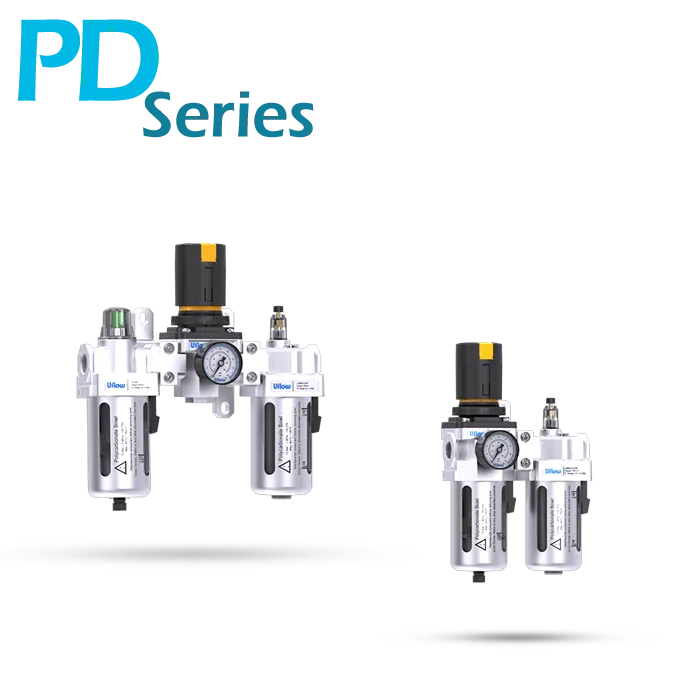
Prevention: this is exactly what upstream air preparation is for. A properly specified filtration and regulation package — such as the PD Series air preparation units — removes bulk moisture, coalesces oil aerosol, and filters particulate down to a size that won't damage seals, all before the air ever reaches the valve. Filtration alone isn't enough on its own, though: condensate has to be drained from filter bowls and receiver tanks on a regular schedule (manually or via auto-drain), or the collected moisture just sits in the system until it's carried downstream anyway.
Standard Nitrile (NBR) seals are the default in most pneumatic valves because they perform well across typical instrument air conditions at reasonable cost — but they are not universal. Nitrile degrades quickly when exposed to certain chemicals, ozone, or sustained high ambient/process temperature, and running a valve outside its rated temperature range — or in an application where the media isn't clean, dry instrument air — accelerates seal wear dramatically. The failure mode is usually gradual: seals harden or swell, clearances change, and the valve starts leaking internally or externally long before it stops functioning altogether, which is why it's often misdiagnosed as "the valve just wore out" rather than a media/temperature mismatch.
Prevention: confirm seal material compatibility with both the operating temperature and the air/media quality before specifying a valve, not after it's installed. Where ambient or process temperatures run high, specify a Viton/FKM seal option — available as the high-temperature PS4/PN4 configuration on the PS4/PN4 Series — rather than pushing a standard Nitrile-sealed valve past its rated range and accepting the shortened service life that results.
A valve sized below the actual flow demand of the circuit is forced to work outside its efficient operating range on every cycle. The restriction generates excess heat at the valve, accelerates wear on the spool or poppet and its seals, and produces sluggish or unreliable switching — symptoms that are frequently misread as a defective valve when the real issue is a port and flow rating too small for the cylinder and cycle speed being asked of it. Because the valve becomes the bottleneck rather than the cylinder, this failure mode gets worse under higher cycle rates, which is exactly when reliable switching matters most.
Prevention: size the valve to actual flow demand with margin for line losses, not to the smallest port that will physically fit the manifold. Port sizing and flow-rating methodology is covered in detail in our directional control valve buyer's guide — the same sizing logic applies whether you're specifying a new valve or diagnosing why an existing one is underperforming.
On solenoid-actuated valves, the coil is frequently the first component to fail, and it's rarely because of a defect in the coil itself. Common causes include coil burnout from incorrect supply voltage, sustained energization beyond the coil's rated ED% (energizing duration) — running a coil continuously that was only rated for intermittent duty overheats and eventually burns the winding — and moisture ingress into a coil with an IP rating that doesn't match the installation environment, which causes short circuits and premature failure in washdown areas, outdoor installations, or humid coastal conditions.
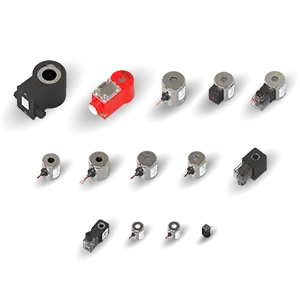
Prevention: match coil voltage and IP rating to both the control panel and the physical environment the valve is installed in, and never bypass a coil's rated duty cycle by wiring it for continuous energization it wasn't designed for. Because coils are a wear item independent of the valve body, replacement Solenoid Coils are stocked as a separate spare part — a burnt coil doesn't have to mean replacing the entire valve.
Running a pneumatic cylinder without adequate cushioning at speed subjects the end caps, piston, and seals to a hard mechanical impact at every stroke end. A single impact rarely causes visible damage, but repeated shock loading over thousands of cycles fatigues the end cap mounting, deforms seal lips, and eventually leads to a cracked cap or a cylinder that starts leaking at the end of stroke — a failure that traces back to the cushioning setup, not a defect in the cylinder itself.
Prevention: specify a cushioned cylinder variant for any application running at meaningful approach speed, and verify that the cushion stroke length actually matches the application's approach speed and load — an undersized cushion length absorbs less of the impact energy and only partially solves the problem.
Most of the failure modes above don't happen suddenly — they develop gradually over weeks or months of operation. A basic periodic inspection schedule catches nearly all of them before they cause unplanned downtime: listening for audible air leaks at rest, cycle-testing critical valves to confirm switching response hasn't slowed, and draining filter bowls on a fixed schedule rather than waiting for a fault. Plants that treat valve inspection as a scheduled task rather than a reactive one consistently see fewer unplanned valve replacements and less production downtime tied to air system faults.
Send us the symptoms and we'll help you diagnose the cause and recommend the right replacement or spare part.