Related Products
Solenoid & Diaphragm Valve Series
DAS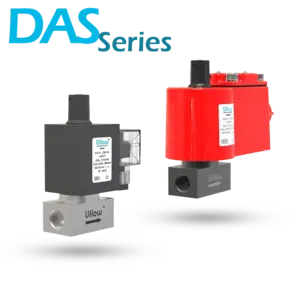
DAS/DAC Series
Direct-acting 2/2 solenoid valve for instrument-grade dosing and small-port shut-off.
View Specs →Both switch flow with a coil — but a direct-acting valve moves the plunger itself, while a pilot-operated diaphragm valve uses line pressure to do the heavy lifting. That difference decides your port size, minimum pressure and cost.
A direct-acting solenoid valve uses an electromagnetic coil to lift — or drop — the valve's plunger directly off its seat. There's no intermediate mechanism: when the coil is energized, the resulting magnetic field pulls the plunger against spring force, opening the orifice; de-energize the coil and the spring reseats it. Because the coil alone does all the work of opening the valve, direct-acting construction is practically limited to relatively small orifices — typically up to around 3/8"–1/2" (10–15mm) — beyond which the coil would need to be impractically large and power-hungry to generate enough lifting force.
The payoff for that simplicity is that a direct-acting valve like the DAS/DAC Series opens and closes purely on coil power, independent of line pressure — it functions correctly even at zero differential pressure across the valve, and it responds in milliseconds. That makes it the right building block for instrument-grade dosing, sampling loops, small pilot circuits, and any application where the valve must open reliably even when there's little or no pressure difference to help it along.
A pilot-operated (or "diaphragm-assisted") valve doesn't ask the coil to do the heavy lifting. Instead, a small integral solenoid pilot controls a bleed passage above a rubber or PTFE-faced diaphragm. When the pilot opens, it releases pressure from above the diaphragm faster than it can bleed back in through a small orifice from the inlet side — the pressure imbalance this creates lifts the diaphragm off the main seat, using the line's own pressure to do the work of opening a port far larger than the small pilot coil could ever move directly. De-energizing the pilot reverses the imbalance and the diaphragm reseats.
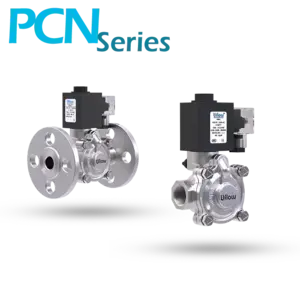
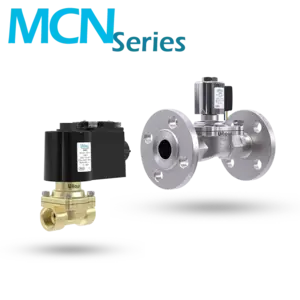
This is what lets a valve like the PCN/PBN Series open port sizes from roughly 1/2" up to 4" or more, at a fraction of the coil size, power draw and cost of an equivalent direct-acting valve. The trade-off is that the mechanism depends on a minimum pressure differential to develop enough force to lift the diaphragm — most pilot-operated valves specify a minimum operating pressure, commonly around 0.5–1 Bar, below which they won't open reliably. For higher-pressure steam, air or water lines, the PBU Series extends the same pilot-operated principle to high-pressure service, while the MCN/MNN Series uses a semi-lift diaphragm design that reduces the minimum operating pressure needed — at somewhat lower maximum flow — for lines that can't guarantee much differential.
The two designs solve the same problem — switching flow electrically — with opposite trade-offs between port size, minimum pressure, and speed:
| Characteristic | Direct-Acting Solenoid | Pilot-Operated Diaphragm |
|---|---|---|
| Port size range | ~1/8"–1/2" (3–15mm) | ~1/2"–4"+ (15–100mm+) |
| Minimum operating pressure | 0 Bar — works fully dead-headed | ~0.5–1 Bar typical minimum ΔP |
| Response speed | 5–50 ms, very fast | 0.3–3 sec, slower (limited by pilot bleed & diaphragm travel) |
| Typical body materials | Brass, stainless steel, PTFE-lined | Brass, cast iron, stainless steel, PVC |
| Coil size for a given port | Scales up quickly with port size | Small pilot coil regardless of main port size |
| Relative cost above 1" | Expensive to impractical | Economical even at 2"–4"+ |
Pick a direct-acting solenoid valve when the port is small, the application needs the fastest possible response, or the valve must open reliably with little or no pressure differential across it — sampling systems, instrument air dosing, small pilot signals, vacuum applications, and any circuit where line pressure can't be relied on to help the valve open. The DAS/DAC Series covers this range in both normally-closed and normally-open configurations.
Pick a pilot-operated diaphragm valve when the port size is 1/2" or larger, the line always maintains at least the minimum rated differential pressure, and cost matters at scale — general industrial water, compressed air and steam shut-off, tank filling, and process isolation are the classic use cases. The PCN/PBN Series is the standard choice here, with the PBU Series for higher-pressure duty and the MCN/MNN Series when your line can't consistently guarantee the standard minimum differential.
Because the coil is the only powered component driving either design, it's also the most common failure point in the field — burnt-out coils, voltage mismatches, and duty-cycle overheating account for the majority of solenoid valve service calls, on direct-acting and pilot-operated valves alike. Both families typically use interchangeable coil assemblies across a given voltage and frequency, so keeping the correct replacement coils on hand for your installed valve population is one of the cheapest reliability investments a plant can make.
Direct-acting 2/2 solenoid valve for instrument-grade dosing and small-port shut-off.
View Specs →Send us your pressure, flow and application details — our engineers will recommend the right valve or cylinder within one business day.