How Ball Valves Work
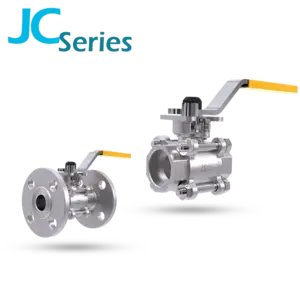
A ball valve isolates flow with a precision-machined sphere that has a bore drilled straight through it, seated between two resilient seat rings inside the body. Turning the stem a quarter turn rotates the ball so its bore either lines up with the pipe (fully open) or sits perpendicular to it (fully closed), with the sphere's own surface sealing bubble-tight against the seats in either position. In a full-port design like the JC Series, the ball's bore matches the pipe's internal diameter almost exactly, so a fully open valve creates negligible flow restriction and pressure drop.
Because the sealing element is a hard, polished sphere rather than a flexible disc, ball valves tolerate higher pressure ratings and more aggressive media — the JC Series is built as a 3-piece body in CF8, CF8M or WCB, rated to 150# and 300# ANSI class, with screwed, socket weld or flanged end connections from DN15 to DN100. The 3-piece construction means the center section can be removed for seat and seal maintenance without disturbing the pipeline connections on either side — a meaningful advantage for lines that can't be easily re-aligned during servicing.
How Butterfly Valves Work
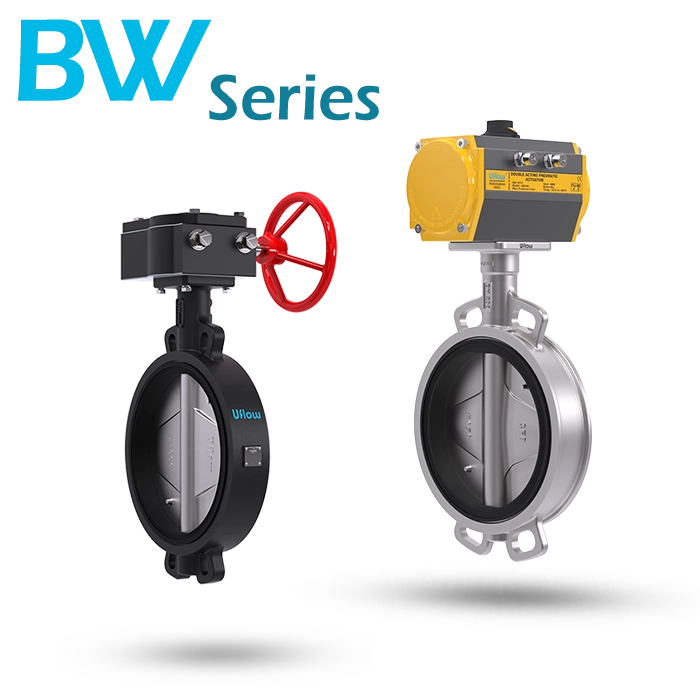
A butterfly valve isolates flow with a thin disc mounted on a through-shaft, positioned at the center of a compact wafer or lug-style body that sandwiches directly between two pipe flanges. Rotating the shaft a quarter turn swings the disc from parallel-to-flow (open) to perpendicular-to-flow (closed), sealing against a resilient liner bonded or pressed into the body bore. Because the disc, shaft and body form a single slim assembly rather than a ball-and-seat cartridge, a butterfly valve like the BW/BL Series is dramatically lighter and shorter face-to-face than a ball valve of the same line size — a real advantage on large-diameter lines where a full-port ball valve would be heavy, expensive and slow to actuate.
The BW/BL Series covers DN40 to DN300 to API 609 in wafer (BW, sandwiched between flanges with through-bolts) and lug (BL, tapped lugs that let the valve act as a line end or be removed without depressurizing the far side) body styles, rated PN06/10/16, with a "Double-D" stem drive that keeps disc-to-shaft play to a minimum for accurate, repeatable sealing across the pressure range.
Even in the fully open position, a butterfly valve's disc remains in the flow path (it simply rotates parallel to it), creating a small permanent pressure drop that a full-port ball valve does not. For lines where minimizing pressure loss matters more than footprint or cost, that difference can tip the decision toward a ball valve even at larger diameters.
Ball vs. Butterfly: Head-To-Head
Both are quarter-turn isolation valves, but they trade off footprint, weight, pressure drop and cost in opposite directions as line size grows:
| Characteristic |
Ball Valve (JC Series) |
Butterfly Valve (BW/BL Series) |
| Size range |
DN15–DN100 |
DN40–DN300 |
| Pressure drop when open |
Negligible — full bore matches pipe ID |
Small but permanent — disc stays in flow path |
| Weight & face-to-face length |
Heavier, longer — full ball-and-seat cartridge |
Light, compact — thin wafer/lug body |
| Pressure class |
150# / 300# ANSI |
PN06 / PN10 / PN16 |
| End connection |
Screwed, socket weld, flanged |
Wafer (between flanges) or lug (tapped, line-end capable) |
| Relative cost above DN150 |
Expensive to impractical |
Economical, standard choice |
When To Choose a Ball Valve
Pick a ball valve when the line is DN100 or smaller, you need true full-port flow with zero throttling drop, or the application demands a bubble-tight shut-off with minimal leakage past the seats — instrument air headers, chemical dosing lines, utility water and compressed gas isolation are the classic use cases. The JC Series 3-piece design also simplifies maintenance, since the center ball-and-seat cartridge can be serviced in place.
When To Choose a Butterfly Valve
Pick a butterfly valve once you're above DN100–DN150, where a full-port ball valve becomes heavy and costly, or where a thin, lightweight body that bolts directly between flanges suits the piping layout better — cooling water, HVAC, bulk process water and large-bore isolation on tanks and headers are the standard applications. The BW/BL Series lug variant is worth specifying wherever a line-end valve or single-side maintenance capability is needed.
Actuation Is Shared Across Both Families
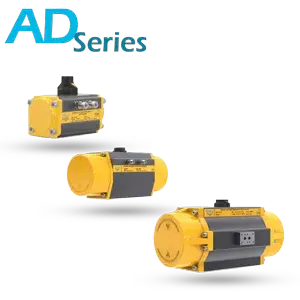
Both the JC Series and the BW/BL Series accept the same range of operation — manual hand lever for small, infrequently-cycled lines, worm-gear operators for larger diameters where manual torque would otherwise be excessive, and pneumatic quarter-turn actuation for automated or remotely-controlled isolation. If you're standardizing on pneumatic actuation across a plant, the AD/AS Series rotary actuator mounts to ISO 5211 pads common to both valve families, simplifying spares and maintenance procedures across mixed ball-and-butterfly installations.
Ball = Full Bore, Zero DropButterfly = Light, Compact, Large-BoreAbove DN150, Butterfly Wins on CostShared ISO 5211 Actuator Mounting